If you’re charged with a crime in Pennsylvania, your cellphone may be the key to proving your innocence. Text messages, GPS data, photos, videos, and deleted files can often show where you were, what really happened, or what was said, often more reliably than any witness. In this post, I’ll explain how cellphone evidence can help you win your criminal case and what steps to take right now to preserve it.
Charged With a Crime? Digital Evidence Could Clear Your Name
Before you delete anything or give your phone to the police, get reliable legal advice. I’ve used cellphone data including text messages, GPS records, Google search histories, and full Cellebrite cellphone data extractions to get charges reduced, dismissed, or dropped entirely.
Call Now for a Free Case Review: (215) 752-5282
Or send a confidential message through my contact form. I respond quickly.
You’ll Get:
- A review of your cellphone evidence and possible defenses
- Guidance on how to preserve texts, photos, messages, and deleted data
- A detailed strategy of how I will use the evidence to prove you are innocent
Key Takeaways: How Cellphone Evidence Can Help You Win a Pennsylvania Criminal Case
- Prove your location using GPS data, cell-tower pings, and app-based tracking
- Show consent or communication context through texts, call logs, and messages
- Establish an alibi with photos, videos, and timestamp metadata
- Recover deleted messages and files through forensic data extraction (Cellebrite)
- Challenge or disprove false accusations in PFA, assault, sex offense, DUI, or theft cases
- Show intent or lack of criminal intent by preserving text messages, voicemail, e-mails, and app messaging
- Strengthen your legal defense to the charges when the evidence is preserved immediately
Important:
Do not delete data or hand your phone to the police. Contact a criminal defense lawyer first for advice on how to preserve digital evidence properly
How is Cellphone Evidence Authenticated?
Before a lawyer can use cellphone evidence in court, they must prove that it is authentic. That can be done in a number of ways including:
- A person identifies a message they sent
- A witness testifies that they know they recognize the identity of a person who sent them a message
- Producing cellphone records from AT&T, Verizon, or Google identifying the sender or receiver of a message
- Using a digital forensics expert to identify the person who sent or received a message
Charged With a Crime? Your Cellphone Might be Your Best Witness
Consider cellphone evidence as a non-human defense witness in your criminal case. Properly acquired and preserved phone data can be even more persuasive and reliable than a person’s memory.
What Are the Different Types of Cellphone Evidence?
Call Logs
Call logs contain the call history on your cellphone. The call log can include:
- Incoming calls
- Outgoing calls
- Missed calls
- The phone number of the incoming or outgoing call
- The contact’s name if the person is already in your phone’s contacts
- The date and time of the call
- The duration of the call
Text Messages
Text messages can be short message service (SMS) or multimedia messaging service (MMS) and may include:
- The content of the messages
- The sender and receiver information
- Timestamps (the exact date and time a person received a text message)
- MMS may consist of audio, photos, and video
Messaging App Data
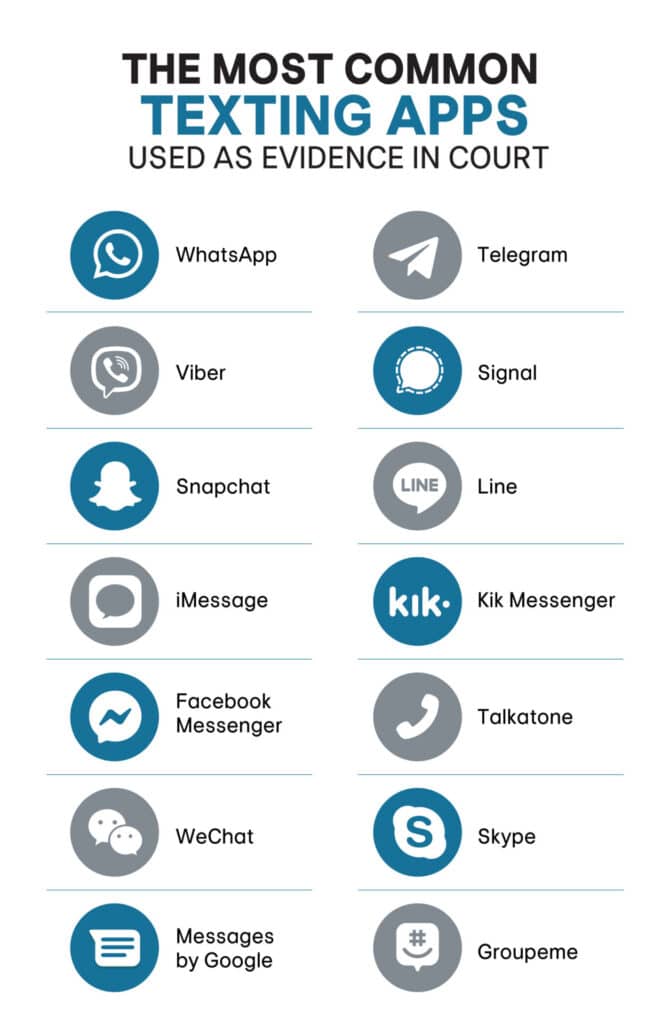
The most common messaging apps include Signal, Telegram, Facebook Messenger, Snapchat, and WhatsApp. You can retrieve the following information from these apps:
- The content of the messages
- The identity of the sender and receiver of the message
- Timestamps (the precise date and time the message was received)
- The content of group chats
Many messaging apps are installed with end-to-end encryption. A message sent through end-to-end encryption is only readable by the person who receives the message. In some cases, an encrypted message can be accessed if the device is unlocked or through cellphone system backups.
Photos and Videos
Most people have many photos and videos stored on their cellphones. Crucial information that can be found in photos and videos includes:
- Metadata is information embedded within a picture or video and can show:
- The date and time the picture or video was taken
- Global Positioning System (GPS) coordinates of where the picture or video was taken if the location services were activated
- The type of cellphone used to take videos or photos
Location Data
- GPS Data (identify exact location pings from any apps using GPS)
- Cell Site Location Information (which cell towers the phone pinged or connected to)
- Wi-Fi Network Logs (Connections to Wi-Fi networks can establish the location of a cellphone user)
Internet Browsing History
- It can show search queries and websites visited by a cellphone user
- It will also show the date and time of the internet browsing activity
- Internet browsing activity can reveal criminal intent (ex., “how to withdraw cash from an ATM without a PIN”)
App Data and Usage
- Social media direct messages
- Calendar notes, entries, and reminders
- Ride-sharing apps (Uber) can identify evidence of where a person traveled
- Fitness trackers can show the movement and location of a person
Voicemail
- Audio recordings left on a person’s cellphone
Device Information Found on The Cellphone
- SIM card information (a card that identifies your mobile network)
- The make, model, and operating system of the cellphone (ex., Samsung Galaxy Edge S25 Edge with Android 15 operating system)
Cloud Backup Systems
Evidence favorable to your case can often be found on a cloud backup installed on the cellphone. Cloud backups store copies of data initially stored on a person’s cellphone. Examples include:
- iCloud
- Google Drive
- Dropbox
- IDrive
Incriminating evidence helpful to your defense, when legally acquired from a cloud backup system, can often prove your innocence.
What About Deleted Data
Forensic extraction tools, such as Cellebrite, can be used to recover deleted internet searches, text messages, call logs, emails, and voicemails.
Contact a Lawyer Experienced in Digital Forensics
Does your criminal case involve a digital forensics defense? If so, contact me at (215) 752-5282 for a free review of our case. I have experience in all areas of digital forensics.
Why is Text Message Evidence Important in a Criminal Case?
Many people communicate by texting apps exclusively today. As a criminal defense lawyer, I understand that text communications are often critical evidence establishing the innocence of persons charged with many crimes.
How Can Cellphone Video Evidence Help Me Win my Criminal Case?
Almost everyone possesses an Apple iPhone, Samsung Galaxy phone, Google Pixel phone, or another type of smartphone. Today, cell phones capture video recordings of virtually any event, from family events to notorious public incidents.
As a result, someone will use their cellphone camera to film most physical altercations, disturbances, and other types of criminal activity. Cellphone video evidence can be critical in establishing a legal defense against a crime.
Examples include proving you were acting in self-defense in an assault case or showing that you were at a different location than the crime scene in an alibi defense case.
Cellphone Photos and Videos
Cellphone photos and videos taken immediately before or after an alleged crime can be compelling evidence to prove that you are innocent.
The cellphone video and photos may show that the accuser was the aggressor in a physical altercation with you, lied about sustaining injuries, made the entire story up, or lied about some other part of the incident.
Permanently preserve this type of evidence, especially if you believe that the other party has falsely accused you of a crime or civil domestic abuse.
Always Preserve Voicemail Messages from the Accuser
I have won many Protection from Abuse and criminal cases based on voicemail messages played in court that directly contradict the accuser’s version of the events. Examples include voicemail messages demonstrating the following:
- The accuser was the aggressor in a domestic violence incident
- The accuser acknowledged planning to frame or otherwise falsely accuse another person of a crime
- The accuser lied to the police about a material fact in the case
Using a Mobile Phone Forensic Expert
For the strongest defense, I will employ a forensic mobile phone data recovery specialist to analyze your phone or the phone of a third party with permission.
The forensic specialist will perform a cell phone data extraction. The results of the phone data dump will often produce evidence proving the innocence of the accused. Examples of exculpatory evidence that can be recovered from a mobile phone include:
- Establishing that another person used your phone without permission
- Recovering deleted data from your mobile device that demonstrates you are innocent
- Retrieving cell phone tower geolocation that proves you were not at the location of the crime
Cellebrite Extraction of a Cell Phone
Cellebrite is the brand name of the software used by the police and forensic laboratories to extract data from a cell phone.
A Cellebrite cell phone extraction device makes a forensic copy of the smartphone’s contents without disturbing or destroying the phone’s integrity. The copy can then be used as evidence in a criminal case.
The process involves connecting the phone to a Cellebrite device, which then systematically retrieves all available data from the phone, including call logs, text messages, outgoing phone calls, incoming phone calls, voicemails, GPS location data, internet search history, and more.
The contents of the extraction report can be viewed using a “Cellebrite Reader.”
Evidence that can be discovered through a complete data extraction of a cell phone includes:
- Deleted text messages to hide criminal activity
- Incriminating internet searches
- GPS location of the phone
- Incriminating voicemails
- Cell phone data establishing the date and time of the use of the phone by someone other than the owner
Client Success Story
I was recently able to get a local prosecutor to drop simple assault and strangulation charges against a client after I had a Cellebrite data extraction completed on my client’s Apple iPhone.
The complainant (the client’s family member) had possession of my client’s phone for approximately 10 days after his arrest before she returned the phone to him.
I sent the phone to a private mobile forensic laboratory in Philadelphia to have a cell phone data extraction report done on the device.
The results of the extraction report demonstrated that the alleged victim used my client’s phone to make unauthorized purchases with his credit and debit cards for over $10,000. As an example, the report uncovered many deleted bank “fraud alerts” that the complainant had overridden.
In a pre-trial ruling, the trial judge ruled that the evidence of the complainant’s credit card crimes and other criminal activity would be admissible in the trial.
The district attorney dropped the charges after being presented with the evidence of the complainant’s criminal activity.
Cell Phone Attorney
Have the police charged you with a crime involving cell phone evidence? If so, I am highly experienced in acquiring, preserving, and presenting cell phone evidence in criminal cases to prove your innocence.
My criminal defense practice area includes Montgomery County, Philadelphia County, Bucks County, Chester County, Delaware County, and the neighboring Pennsylvania Counties. Contact me at (215) 752-5282 or fill out the contact form for a free assessment of your case.
Proving Consent in a Pennsylvania Sexual Crime Case
The Pennsylvania Crimes Code contains many sex crimes. The most common sexual offenses the police will charge include rape, sexual assault, and indecent assault. In many cases, there is no physical evidence, and the prosecutor’s evidence relies entirely on the accuser’s statements.
Consent is a legal defense to most sexual offenses in Pennsylvania in cases where the accuser is an adult.
Most juries will not convict the accused if the accused presents evidence of text messages or voicemail messages between the accused and the accuser demonstrating that the sexual encounter was consensual.
In many cases, I can bolster a consent defense to a sex crime by presenting photos or video evidence proving that both parties consented to the sexual activity.
Alibi Defense
What is an alibi defense. In Pennsylvania, an alibi defense places you at a different location on the date and time of the crime. As such, an alibi proves you couldn’t have committed the crime.
In Pennsylvania, alibi evidence alone or combined with other evidence is sufficient to establish reasonable doubt of the defendant’s guilt. Also, a criminal jury must render a not guilty verdict if they believe the accused has established an alibi for the crime.
Different forms of digital evidence can be highly persuasive in establishing and proving an alibi defense for a crime. What is an example of an alibi. Your phone can be analyzed to verify that it was pinging off of cell towers located far away from the crime on the time and date of the event.
What are Different Types of Alibi Evidence?
Alibi evidence can come in many different forms. The common feature of all alibi evidence is that it establishes that you were not at the location of the crime and, therefore, could not have committed the criminal act. Examples of alibi evidence include:
- Testimony from a person who was with you at a different location at the time of the crime
- Cell phone video showing you at an alternate location at the time the crime occurred
- Surveillance video that places you at a different site than the place of the crime
- Cell tower “ping” records that establish that you were not present at the crime scene when the crime occurred.
An alibi defense, if believed, is a complete defense to a crime in Pennsylvania.
Preserve Text Messages to Build a Strong Defense
The primary ways to secure text messages as evidence include:
- Use the screen capture feature on your iPhone, Samsung, or Google device and email the texts to yourself
- Email or forward the text messages to a different device, such as a laptop computer
- Maintain two copies of the communications for yourself and your lawyer
- Make sure you are preserving the entire conversation, including your responses to the text messages
Has the local Sheriff or police served you with a false PFA based on text messages? Review my PA Protection from Abuse (PFA) Defense Lawyer page to understand how to defend yourself in court.
How Are Text Messages Authenticated in Court in Pennsylvania?
You can use text messages as part of your defense if you can show that the messages were sent or written by the accused by presenting the following evidence:
- Direct evidence, such as the testimony of a person who witnessed the accuser writing the text messages
- The accuser admits that they wrote the texts
- Identifying characteristics of the message that proves that the accuser wrote it
- Proof of ownership, possession, control, or access to a device or account at the relevant time when corroborated by evidence indicating that the accuser authored the message
Frequently Asked Questions (FAQs)
Can the police search my cellphone without a warrant or my consent?
No. In most cases, the police need a search warrant to access your phone. Talk to a criminal defense lawyer before turning it over.
Is deleted cellphone data still useful?
Yes. A digital forensic expert can often recover deleted texts, images, voicemails, and call logs vital to your case.
What if I already handed over my phone?
Contact a criminal defense attorney right away. They may still be able to access and preserve the data properly.
Get Immediate Help from a Bucks County Criminal Defense Lawyer
Are you facing sexual assault, simple assault, or aggravated assault charges? Cellphone evidence may provide you with a powerful defense.
I offer aggressive criminal defense to persons charged with crimes in Montgomery County, Philadelphia County, Bucks County, Chester County, Delaware County, and the nearby Pennsylvania Counties.
Contact me at (215) 752-5282 for a free consultation of your case, or fill out the confidential contact form for an immediate response.